Showing posts with label opinion. Show all posts

Thursday, October 22, 2009

Ruffed Grouse, and stuff...

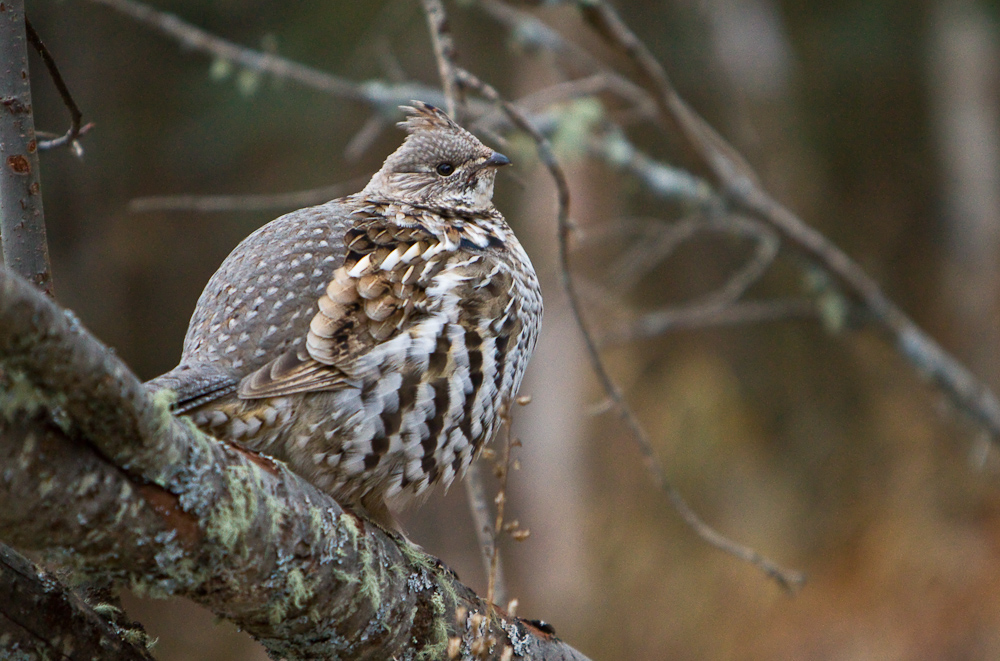
Ruffed Grouse
Canon 7D, 70-200f2.8L IS, f2.8, 1/200th second, ISO 1600, handheld.

This lovely Ruffed Grouse visited a tree just outside one of my cabin's windows day before yesterday. I had just a moment to snap an image or two before it wandered off into the woods. Which leads me to a thought:

Chase Jarvis the excellent commercial and lifestyle photographer and teacher, has a new book out called The Best Camera (is the one that's with you). It is a collection of his images shot from his iphone as well as some thoughts on opportunistic photography. I haven't read it, and probably won't for a while. Nothing against the book, I'm sure its great, but I've got a stack of photo books I'm working my way through and that one is way down at the bottom somewhere. However the POINT of the book is very clear- Have a camera with you. Always. The image above is representative of that. It seems like, much to my girlfriend's chagrin, that I always have a camera somewhere within arm's reach. Camera gear is scattered about our very small cabin, and it constantly gets in the way. But THIS is why. If I'd had to go digging for a camera, the grouse would have wandered off and I would have missed it entirely. But because I had my 7D sitting on a nearby chair, mounted with the 70-200, I got the image. No it isn't as good as it would have been had I had the chance to mount up the 500 on a tripod, but it's a perfectly acceptable image that I got because I was ready. So carry a camera. Always.

Thursday, February 26, 2009

Throw away images

Back in the days of slides, before I made the switch to digital, I loved getting back my images, neatly packaged in boxes from the developer. I'd pull them carefully from their cases, lay them out on the light table, flip the switch on the table and watch the images come to life with the glow. Then the loupe came out and I'd lean over each image to examine it, check for color, focus, composition... Then I'd throw 75% of my beloved images straight into the trash.

And rightfully so. At least 75% and probably more like 90% of the images I took were garbage. But what of those images? Did they fill the gaps in the stories I wanted to tell? Or were they extraneous, adding nothing? Probably it was a bit of each, but editing, severe, heartless editing, is probably the most important thing outside of the snapping the image that we do as photographers. Now of course, I do it all digitally, and I've gotten good at it. A few days ago I made more than 200 images of my backyard birds and edited that selection down to the five images I posted here. I nixed about 98%.

What got me thinking about this was a BBC article I stumbled on today about Robert Frank's classic book The Americans. The article is about the images that did not make the cut, some of which were good images, but they failed to fit into the piece the way he had imagined. This is the importance of vision, of understanding where we want to take our art. Frank was telling the story of the American people, and some of his images, even good ones, didn't fit that tale. So he tossed them out. The article ends with this paragraph, which I like:

And this is the point - Frank had the desire and courage to throw away good frames. He had something to say, and that's the power of photography. To have a point of view at the heart of the work is what projects this photographic document to the top of the heap, even 50 years on.

Something for me to ponder the next time I pick up my camera.

Find the BBC article HERE.

Monday, February 16, 2009

Know the Rules, Then Break Them

Photographers love to make rules about how a good image should look. Then of course they say with superiority how you really shouldn’t follow all those rules of convention anyway. Today, I thought I’d write, in a bit of detail, about one of the most hallowed of photographic laws. It is known as “The Rule of Thirds”.

The premise is straightforward: the subject of an image should fall on the lines that divide the frame in thirds. Like so:


Following this rule generally creates pleasing images. Subjects placed in the center of the frame often look unbalanced. Today, I thought I’d take a few images from a recent trip to Big Bend National Park as some examples of how this works: The first shot is a pleasant desert landscape that adheres closely to the rule of thirds:


Now let’s drop some third lines across the image so you can see what I mean.


Notice how the agave plant in the foreground falls almost exactly at the meeting point of two, thirds lines and the top of the mountain on the upper left is just about meeting the top third line. The peak on the upper right and the plant play off each other nicely. This makes a nice well-balanced composition.

The next two shots are birds. Now at some point, I’ll probably do another post on my thoughts on bird photography in particular but in the mean time, lets stick to these two images. Both follow the rule of thirds. The first is a horizontal image of a male Western Bluebird:


Below you can see here how the third lines bisect right through the bird. This composition is typical but effective in the situation where the subject is too distant to provide a frame filling image. Also note the way the bird looks into the frame and the way it's downward tilting bill emphasizes the angle of the branch.


The next is a vertical image and the same rules apply here as well. This one is an Acorn Woodpecker foraging up the side of a dead tree:


And with the third lines in place, the lines hit very close to the bird’s eye, which is usually the focal point of a wildlife shot.


Next we start to bend the rules a bit. Panoramic images already disrupt the familiar rectangular format. They spread across a horizontal (or rarely vertical) plane to expand the view. It creates the sense of an expanded horizon, and occasionally this is the case when multiple images are stitched together. However, often panoramics are simply regular photos cropped to fit the format, as is this image of the Chisos Mountains:


I chose the format to emphasize the length of the rainbow and the similar shape of the mountains dropping into the surrounding desert. Now when I throw a thirds grid over this image, stretched to fit, you can see how the same rule of thirds actually applies in this format as well.


The mountain top hits the top line and the rainbow bends through the top line twice, while the horizon line angles left more or less along the lower third.

As with any rule however, the rule of thirds can, and should, be broken. This is becoming particularly true in advertising and fashion imagery. Look through the New York Times Magazine fashion section on any given Sunday and you’ll see the rule of thirds thrown out the window on almost every image. Because the rule of thirds is so often used, the “recipe” is familiar and to push boundaries it must be broken. This works well with advertising products that are also trying to push boundaries. It makes an important statement when the style of clothes and style of photos combine. Landscape photography is not at the cutting edge of photographic art. We, meaning the general photographic audience, still like classic landscapes. Pushing the conventional boundaries (sweet light, saturated colors, complimentary lines) does not yet happen on a regular basis. Now that isn’t to say the rules are never broken, but the situation must warrant it, unlike fashion photography where the rules are broken on principle. One example of a situation warranting a break with convention is the image below. In this image I wanted to emphasize the mosaic of clouds while still providing enough of the landscape. Here I was trying to demonstrate the sense of space that dominates the desert of Big Bend. I like this image quite a bit, but notably it wasn’t among those from my Big Bend series recently selected by an editor for publication in a photo magazine.


And here I’ve taken the same image and dropped a grid over it. You can see how the horizon line falls substantially below the 1/3 line:


The moral of the story is this: Just like legislative laws, know the rules, they exist for a reason, but don’t follow them blindly, constantly question why the exist and break them when you should.

Thursday, February 12, 2009

Photography Advice from Strunk and White


Anyone who has taken a college level English or Creative Writing class has likely stumbled upon a little book entitled The Elements of Style. This is a classic about writing the English language, but despite its bland subject matter (grammar) is a surprisingly fun read. It is not to teach you grammar that I write this post. Rather, as I was paging through the book last night, I found a short passage from E.B. White's introduction quoting William Strunk that I found interesting:

Vigorous writing is concise. A sentence should contain no unnecessary words, a paragraph no unnecessary sentences, for the same reason that a drawing should have no unnecessary lines and a machine no unnecessary parts. This requires not that the writer make all sentences short or avoid all detail and treat subjects only in outline, but that every word tell.

It struck me right away how that paragraph can easily be interpreted to photography. In fact I think that is the best non-photographic, photographic advice I've encountered. So bear with me as I take the liberty to re-write it in photographic terms:

Vigorous photography is concise. An image should contain no unnecessary elements, a photo essay no unnecessary images. This requires not that the photographer make all images simple or avoid all detail and treat subjects only in the abstract, but that every element counts.

I think that last bit is the key to the it. Include what you need, and nothing more.

Wednesday, February 11, 2009

A few words on gear

For all my ranting in previous posts about how much gear doesn't matter, I still own and use a lot of it. And because "What kind of camera/lens/tripod/filters/memory cards/backpack/toothbrush do you use?" is the one question I get most often, I thought I'd answer that right away. Here is a quick list and some thoughts on my gear:

1. Tripod- Gitzo GT5540LS- (carbon fiber 4 section legs)/Kirk Ball Head/Wimberly Sidekick
Let's start with the most important piece of equipment in a photographer's quiver. No I'm not talking about the camera (that is assumed) I'm talking about the TRIPOD. If there is one tool that will improve your photography it is this. Now mine is particularly good. I finally got around to buying the best because I got sick of messing around with and being frustrated by cheaper models. But even an inexpensive one will greatly improve your shooting. If you don't have one, go get one. Now.

2. Camera bodies: Canon 40d and Canon 20d and a Canon G9 point and shoot.
I carry two bodies on most of my adventures. It gives some comfort if one of them croaks to have a backup. Plus when the shooting is fast and furious I can mount them both up with different lenses. The 40d is a good mid-level camera, I have very few complaints. Good noise reduction up to about 400 or even 800 ISO, big screen and live view. The 20d is a bit out-dated but it has been very reliable for several years now and I refuse to get rid of it until I can afford to upgrade. The G9 is a great little camera to carry around. It gives publishable results and is RAW capable. Most importantly it goes everywhere.

3. Lenses
A. Canon 70-200 f2.8L - This is my all time favorite lens. Great range, sharp, fast, good bokeh and works for everything from portraits to landscapes to wildlife. Worth every dime of its hefty price tag.
B. Canon 17-40 f4L- My wide angle. When I'm not shooting wildlife I keep this lens mounted up on one of my two cameras with the 70-200. Good, sharp, but I wish it was a stop faster.
C. Canon 500 f4L- The big lens in my quiver and my standard for wildlife. It is big so draws a bit of attention which can be a problem when I'm trying to concentrate on something, but is a good conversation starter at slower moments. It is sharp, fast and takes the 1.4x or 2x Canon teleconverters for extra magnification (though my bodies won't focus automatically with the 2x).
D. Canon 100 f2.8 macro- As much as I love to shoot macro shots this lens doesn't get a lot of use. When I'm packing light, this one stays at home. Still, it has great bokeh, works as a surprisingly good portrait lens and easily magnifies to 1:1.
E. Sigma 30mm f1.4- Since I bought the 17-40 this one also sees less use. I still like the lens a lot. It is sharp, very fast and proves that you don't have to have Canon lenses to have good glass. Plus it was fairly inexpensive for this good of a piece of equipment.

4. Flash- Canon 420 EX Speedlight.
This is a notable weak point in my gear list. It does fine, but just that, no more.

5. Accessories
A. On-flash soft box for portraits- useful in the right circumstances.
B. Flash extender/magnifier for telephoto work- Useful for fill-light on wildlife.
C. Polarizers for every lens but the 500mm- These are on my lenses almost all the time.
D. Cabled remote trigger- Vital for long exposures, and for maximum sharpness.
E. Cable flash extender- Useful for adjusting flash direction.

6. Packs
A. Mountainsmith Paragon- This is mostly my storage pack at this point.
B. Crumpler Brazilian Dollar Home- This is my main bag. It can handle all my photo gear minus the 500, my laptop and accessories. It organizes strangely from the top which makes quick access to stuff lower down a bit tricky, but it is a shoulder bag which allows me to work out of it when needed. Also, because it is a shoulder bag, I've never even gotten a sideways look from airline personnel when carrying it on.
C. Custom made Apocalypse Design case for the 500- This is a basic rectangular padded case with handles and a shoulder strap. It can hold the 500 with camera and teleconverter mounted on it. When I travel I carry this and and the Crumpler as my carry-ons. I've never had a problem, though it all gets a bit heavy on long walks between gates.

D. Many pocketed waist belt designed for archery- This is large enough to hold a wide angle lens, filters, extra batteries, a small water bottle, snacks and other knick-knacks when I'm shooting in the field. I attach the case that came with the 70-200 onto the belt to hold that lens when not in use. It provides easy access to all my stuff without having to take off a backpack. This is a much cheaper though perhaps somewhat less functional alternative to the excellent system made by Think Tank.

That is the bulk of my gear. The fact is that no matter how much crap you own it is you that makes the images. The cool lenses, tripods and bodies are tools to get the images you want but tools only. They cannot replace the photographer's eye, artistic sense, or emotion. Start with the art and then start worrying about stuff.

Wednesday, February 4, 2009

What I'm reading

My bookshelves are covered in photography books and with all due respect, a good portion of the how-to guides are crap. There are a few jewels in the rough, generally those that move past the technicalities and into the philosophy and the thought process of the artists. Galen Rowell's The Inner Game of Outdoor Photography and Phillipe L. Gross' The Tao of Photography: Seeing Beyond Seeing are perfect examples. These are the kinds of books that move beyon f-stop and depth of field to discuss how to see, find, and interpret images. In other words how to make your photography art.

Right now I'm reading another book that tried to blend, somewhat successfully, the art and the science of imagery. It is called The Photographer's Eye by Michael Freeman. I'm enjoying it overall. The text is well thought out and here I think, in that respect, he is on the right track, but I'm finding many of the images less than compelling. Then again, I'm not far into it and that may change. Perhaps I'll post a more detailed review at some point later.