Showing posts with label philosophy. Show all posts

Tuesday, November 10, 2009

Another Moose Image

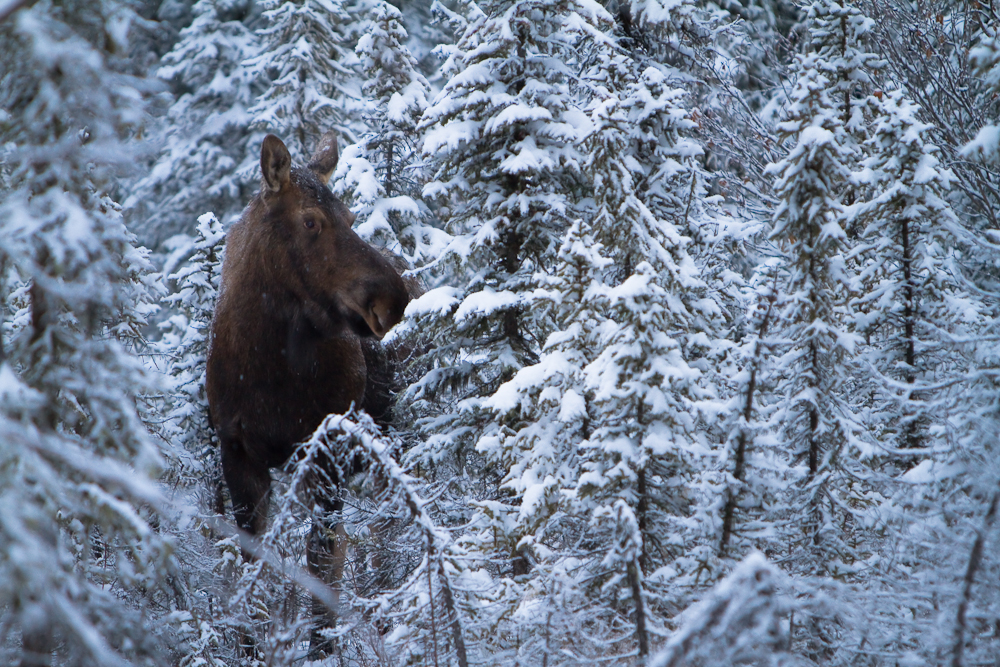
Moose in snow
Canon 7D, 70-200 f2.8L IS @ 200mm, 1/100th sec, f2.8, ISO 800, +.25 Exposure Compensation

I mean really, can you actually have too many images of a moose?

This is another from the series made a while back. It is a bit different perspective, though I was still trying to tell the same story as the image I previously posted. In short: Moose live in dense brush and are surprisingly hidden for huge animals. I also like the clearly winter aspect of the scene. One thing I prefer about this image is that the animal is not facing me directly. In wildlife photography, a little eye contact can create some visual tension which is good, but what it means is that the animal was aware of you, and more importantly, paying attention to you. That, is not good. In the previous image, I was a obtrusive and influencing the animal's natural behavior which is generally to be avoided. This image shows the moose paying me no mind, merely looking around its habitat (at the other moose that was there actually). In this shot, there is no evidence aside from the image itself that I was even there. Wildlife photographers should be that way, invisible except for our vision of the scene.

Monday, October 26, 2009

Return of the Winter Birds

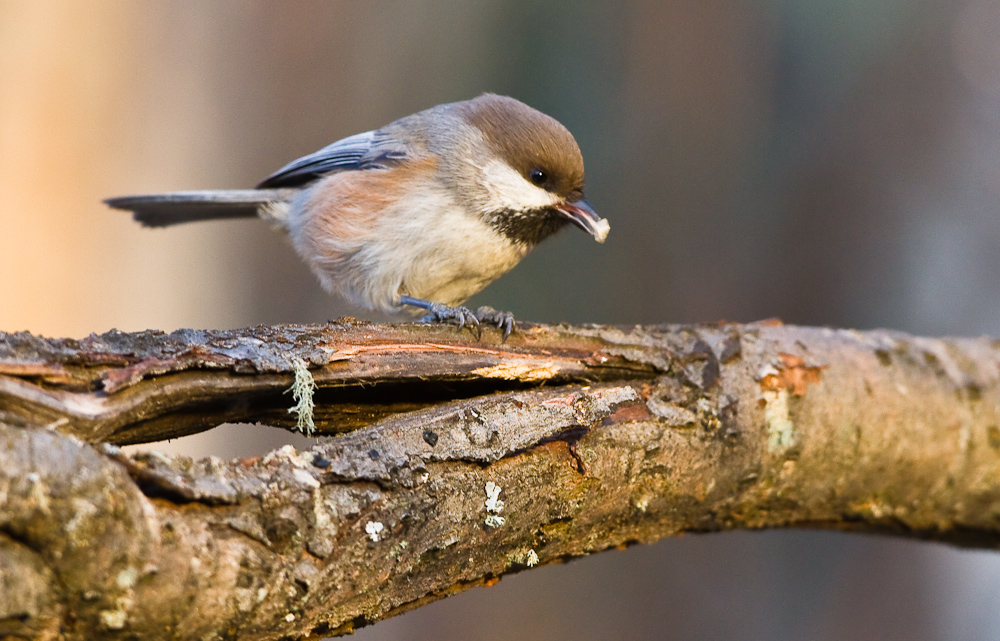
Boreal Chickadee
Canon 7D, 500mm f4L IS, Tripod mounted, 1/80th @ f5.6, ISO 800.

I mentioned a few days back how, now that winter is arriving, the light is long and sweet for most of the daylight hours. Well its true, but in exchange, we have many fewer hours of light. In fact today we declined down to 8 hours and 28 minutes of possible sunlight, a loss of about 6 and half minutes over yesterday. But that is all beside the point. Yesterday I took advantage of the last hour of daylight to shoot the birds around our feeders. I've been trying for awhile to get a really excellent image of a Boreal Chickadee, but I still haven't attained it. The one above is fine, but not much more than that. Getting the perfect image takes a lot of time and effort, and I'll be working on this one for awhile. I think part of the problem is that I'm having a hard time visualizing exactly what I want from the image. This part of the creative process of photography that is most difficult for me. Determining what I want before I go out and try to get it. It is best to have some idea of the story you want to tell. In this case, I want to say something about the bird, its natural history and habitat, its ability to survive the cold. The image above does none of those things. Rather is a simple portrait, eating a sunflower seed no less. Hardly a natural food source here in Fairbanks.

My point in all this rambling is to think about your photos before you go out and try to make them. Ask yourself what story you want to tell and then think hard about what image will tell that story, then work to make the image. I'm still struggling with this myself.

Monday, March 23, 2009

OK- Bird Photography

Beware! The following is a long, opinionated, and possibly blatantly wrong series of thoughts on the art of bird photography.

Arthur Morris. There you go. That name says a lot about the current state of bird photography. Artie, as he calls himself, is an extremely talented photographer who has made his reputation with his own “brand” of imagery. His trademark is close shots, often portraiture, of wild birds in low angle, over the shoulder light. Very sharp with clean even backgrounds. It is stylish and simple. It WAS a distinctive look. I emphasize the word WAS because Artie’s work has become so synonymous with good bird photography that it seems every photographer shooting birds is doing their damnedest to imitate his style. Close. Sharp. Clean. As a result (and this is where my opinion rears its ugly head) run of the mill bird photography has become very, very, boring. The birds are beautiful and photographed in nice light they are usually in profile (ideally with the head turned 15 degrees toward the camera). The images are technically perfect and they all look exactly the same.

This striving for the “ideal” shot has led to a remarkable reliance on Photoshop. The program is used to clone out distracting elements (even very minor ones), to clean up non-uniform backgrounds, to remove unwanted parts of the image (other birds, evidence of humans, etc.), and even, in the more extreme cases, to replace parts of the bird that are not shown in ideal conditions with parts from other images. Thus it is possible to find shots of birds where a closed eye has been replaced by an open eye from the next photo in the series. A clipped wing may be replaced with one copied from the opposite side, feathers re-arranged, dirt removed from bills, feet placed in more aesthetically pleasing positions… WHERE DOES IT STOP?

At what point have we stopped portraying nature as it is and turned it into what we want it to be? I don’t think this is just a philosophical question. Nature photography has been criticized in the past for portraying nature as an ideal and not as reality. The late, great Galen Rowell received a scathing critique from an art critic who said that he was misleading the public through use of “colored filters” to believe that nature was a bright and colorful place when in fact it was mostly, brown, green, and gray. That critic was obviously wrong and I pity them for having spent so little time outside not to have seen the colors the world can produce. But if Galen’s true to life images could give that impression, what would that critic say about the kind of manipulations now common in bird photography?

But Dave, you say, we are talking about art not reality. In which case I say “touché…BUT…” photography is different. I’m sorry, but it just is. People, the viewing public, look at photography very differently from other forms of art. People BELIEVE photography in a way they don’t with other art forms. And when it comes to nature photography, well, I think nature should be appreciated in all its diverse forms, and our images should represent this, not just showing all the rare moments when our avian subjects appear in perfect light with clean backgrounds with their bills pointing exactly 15 degrees off of perpendicular. OK that was an off-subject tangent. My point is not that bird photography shouldn’t be viewed as art, but rather that bird photography shouldn’t all look the same.

The strange part is that I think many bird photographers recognize this in their gut. Because when the rare image appears on the Bird Photographer’s Network that has truly broken away from the formula like this one HERE. It gets rave reviews. Others, that I think are rather stunning with hidden textures and surprises like this one HERE, get notably mixed reviews because, in the eyes of many photographers, the image is close enough to being “correct” that it is wrong.

Now, after I wrote all this, I must acknowledge that I do love a good clean bird photo. These shots are easy to appreciate, and given the right situation and equipment are technically easy to execute. They illustrate the written word very well, but they are rarely memorable. The simple, the clean and sharp, may be the bread and butter of the wildlife photographer, but it should never be the only images made. As photographers we must remember to expand our vision beyond the normal. It is outside of the norm where we will find the truly exceptional.

Rant over.
Wednesday, March 18, 2009

Thoughts on a new book

I'm in the first pages of a new book: Creativity: Flow and the Psychology of Discovery and Invention by Mihály Csíkszentmihályi. It is certainly a book on psychology, but it offers a lot of insight into the creative process. I imagine over the course of the next week or so that I'll be writing more about it. The book has immediately provided me with some food for thought. Last night as I was trying to keep my tired mind concentrating on the book I found a short passage that talked about how age relates to expertise in different disciplines. The author (god forbid I have to spell his name out again) notes that skill and problem solving abilities in mathematics (a science with discreet, known, rules) peaks in the mid 20s. Skills in many other sciences, (chemistry, economics, physics, etc.) which have less distinct rules takes until the mid-30s to peak. But disciplines that have few rules like literature and philosophy take until a person is late in life to master or reach the best of their abilities. It seems that life experience is vital in these disciplines. There is a clear progression.

Where then does photography fall on this line? No doubt that photography has a technical side, even a scientific side, but much more importantly it is a creative endeavor. I venture then that I can spend a lifetime and still progress as a photographic artist. This realization is great big bag of mixed blessings. It means that as long as I work at it, I will continue to improve. But it also means that that true mastery is perpetually out of reach.

Thoughts?

Tuesday, March 10, 2009

Something in the Water


What is it with creatives right now that everyone seems neck deep in artistic introspection? David duChemin is spending the week re-evaluating his photography, shooting things way out of his normal range and not mentioning one word about gear. Zack Arias recently posted a widely viewed video on his inner struggle as an artist (I posted a link to this a few days back). And I've been tearing through books on the creative process and doing my best to see things...differently.

In one of the final chapters of The Photographer's Eye, the author writes about the kind of image we are trying to create and asks: Are we making an image to appeal to the most people or making an image that is unconventional and pushes the viewer? For a long time, I've found myself in that first, group. There isn't necessarily anything wrong with that, but it IS stunting. Of course I want people to like my images, but I don't want them to be liked because they've seen them before. I once had a comment on one of my images where the viewer said, in a very complimentary way, that the shot looked like an Ansel Adams. But, I don't want my images to look like an Ansel Adams, I want my images to look like a David Shaw.

But what does a David Shaw image look like? Now that's tricky because my vision is constantly shifting and I don't want my images to look how they do right now, I want my images to look how they will be when they are the best I can make them. Thus I'm trapped in a viscious circle of constantly trying to be better than I am. This circle is a dangerous, often frustrating, but at times glorious place to be. As I spin in my circle, pushing my photography, I accumulate thousands of really, really bad images and a few that allow me to spin off in a new and better direction. With those few, I get to see things differently, see things better. And the more I push, the clearer my vision becomes.

Now all of this is not to say that I think we should ignore other artists to pursue our own vision. That, I'm sure, would lead us into a very dark place. Rather we need to see the images of others, explore them, learn from them, even emulate them. But the moment we start immitating them we've lost our own art. I know, I 've fallen into that trap and while down in the hole, I had lots and lots of company.

We need other artists to provide feedback, to be honest, and not ingratiating. We need the community,and the spirit that comes from being among others of the same mind. We need expertise, in our fields, and to constantly push ourselves to see the world with greater clarity.

Sunday, March 1, 2009

Intent


I've been working my way slowly through "The Photographer's Eye" (which, incidentally, is improving by leaps and bounds) and last night I read the chapter on intent, which got me thinking about the concept. Since I've got this spinning around in my head, I thought I'd try to dump some of it out here:

The success of an image, (and here I'm writing about my own images) depends heavily on whether what I intended actually appears in the image. Another viewer may see the image and enjoy the subject, light, or whatever, but if it doesn't show what I wanted, the way I wanted, the image will often end up in my hard drive's trash bin. The intent can be very simple, such as showing a play of light or a pattern on the landscape. It is when the intent becomes more complex that the image itself becomes far more complex. This complexity is particularly important in the making of the image, but can be as well in its viewing.

Let's use the image above as an example. I made the shot last May in Florianopolis, Brazil. The shot was taken out of the window of an oyster restaurant. The lagoon is just inches out of the frame on the right side of the image. It was just past sunset. What drew my attention was the way the straight parallel lines of the roof contrasted with the jagged edges of the chipped paint and the curved top of the shuttered window. Showing that pattern and the light on the subject is about as far as my intention went. As far as it goes, I think I succeeded, simple intent resulted in a simple image.

Now let's jump on to the viewer's perspective. This is where things get fuzzy. Because you see, when the image isn't accompanied by text, it is completely open to interpretation. And as I try to look at this as a third-party viewer I could see this interpreted in numerous ways: the pattern of rooftop and cracked paint I intended, a statement of poverty, age, decay, or third-world lifestyle. I'm sure there are others.

What I'm getting at as I explore all this, is that what the photographer intends is not necessarily what the viewer will receive. So what is the point of intent? Perhaps most importantly it provides motivation for the photographer, thought, and mindfulness. And more than just about everything else, more important than our equipment or our location is the thought that goes into our images. When we put in effort, our images are get better, regardless of how they are interpreted.

There is more too it than that, of course, but this is as far as my head spinning has gotten. More later.

Thursday, February 26, 2009

Throw away images

Back in the days of slides, before I made the switch to digital, I loved getting back my images, neatly packaged in boxes from the developer. I'd pull them carefully from their cases, lay them out on the light table, flip the switch on the table and watch the images come to life with the glow. Then the loupe came out and I'd lean over each image to examine it, check for color, focus, composition... Then I'd throw 75% of my beloved images straight into the trash.

And rightfully so. At least 75% and probably more like 90% of the images I took were garbage. But what of those images? Did they fill the gaps in the stories I wanted to tell? Or were they extraneous, adding nothing? Probably it was a bit of each, but editing, severe, heartless editing, is probably the most important thing outside of the snapping the image that we do as photographers. Now of course, I do it all digitally, and I've gotten good at it. A few days ago I made more than 200 images of my backyard birds and edited that selection down to the five images I posted here. I nixed about 98%.

What got me thinking about this was a BBC article I stumbled on today about Robert Frank's classic book The Americans. The article is about the images that did not make the cut, some of which were good images, but they failed to fit into the piece the way he had imagined. This is the importance of vision, of understanding where we want to take our art. Frank was telling the story of the American people, and some of his images, even good ones, didn't fit that tale. So he tossed them out. The article ends with this paragraph, which I like:

And this is the point - Frank had the desire and courage to throw away good frames. He had something to say, and that's the power of photography. To have a point of view at the heart of the work is what projects this photographic document to the top of the heap, even 50 years on.

Something for me to ponder the next time I pick up my camera.

Find the BBC article HERE.

Thursday, February 19, 2009

More on the Rules

My post on the rule of thirds from a couple of days back got me thinking about these rules. And it occurred to me that much of the photography I admire does not follow photographic rules of any kind. The images are often "incorrectly" exposed, unsharp, are crowded, and do not adhere to any guidelines for composition. But they have passion. Great examples of this can be found on the Magnum Photo Blog and on the recently formed Burn Magazine. (Really, go check these out right now, and then come back and finish reading this entry so you know what I'm talking about. Go on. Go.)

OK, now that you've seen some of these images I can go on:

As I think about this, I realize that the things I usually shoot, nature, wildlife, even travel portraiture adhere to more strict rules. Actually, that isn't fair. It's the WAY I shoot nature, wildlife and travel portraiture that follows more strict rules. But seeing these images so different from my own, reminds me of what the art of photography can be. There is only one rule that matters: demonstrate passion, emotion, and honesty. How you go about it is up to you. The images you end up with will be the judge of your success.