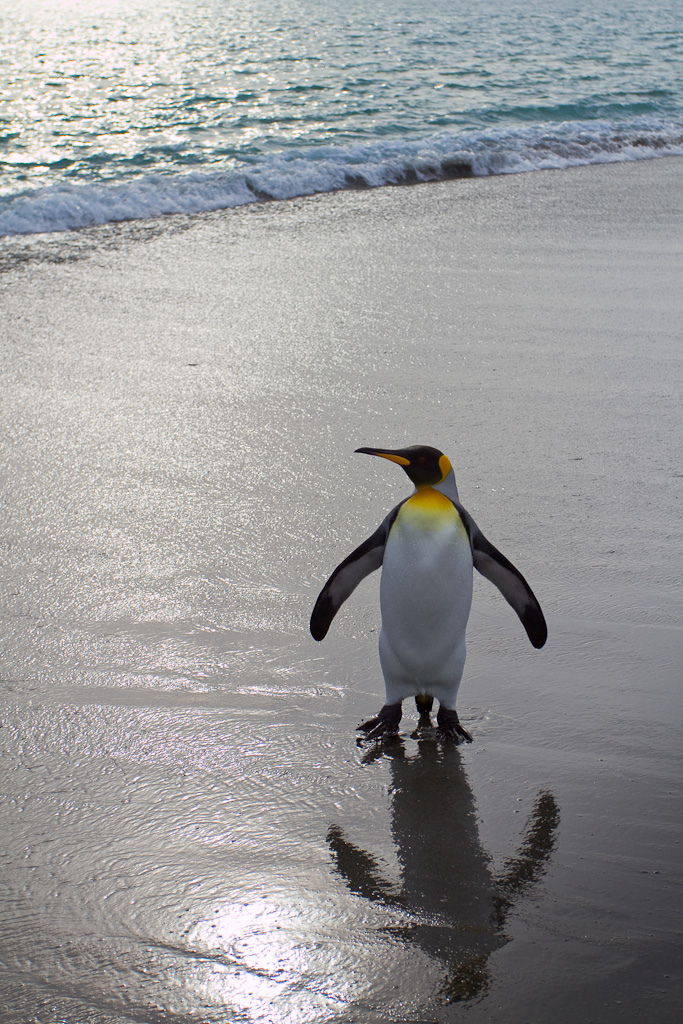
Showing posts with label South Georgia. Show all posts

Friday, February 19, 2010

Fur Seals: Striking Fear in the Hearts of Men

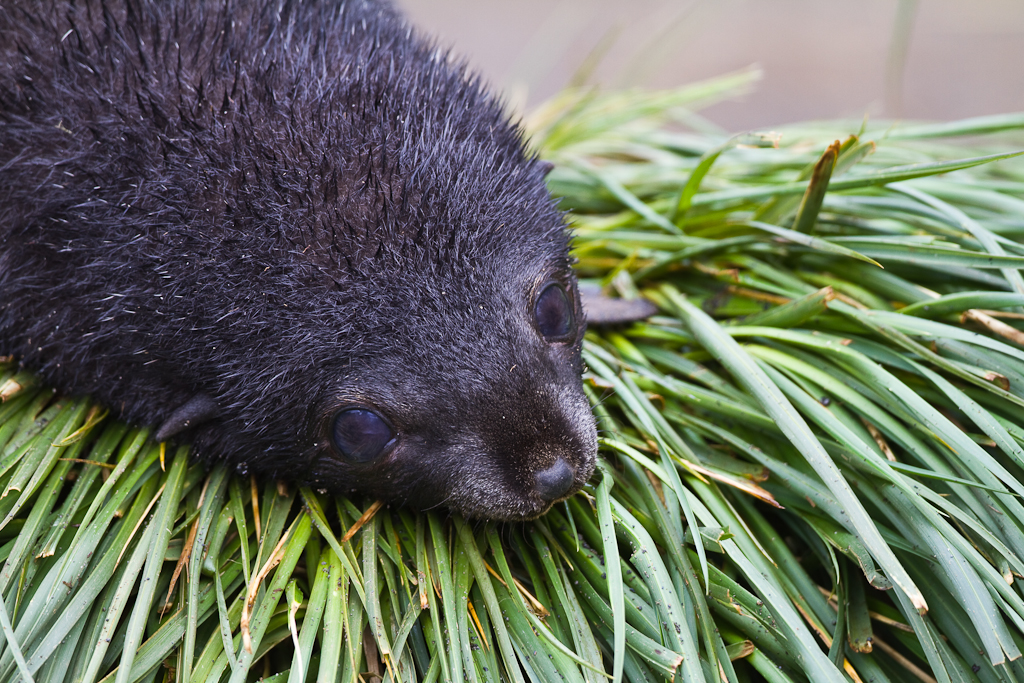
Antarctic Fur Seal Pup
Canon 7D, 500mmf4L IS, 1/200th @f4.5, ISO 200

Look on ye short of bravery! Look deep into those dark, fierce eyes! Do they not strike fear into your heart? Do they not fill you with terror?

No?

Well they should. Because this little guy, cute as he may be, a few years from now will be leaping out of the tussocks, snarling like a pit-bull as you pass. This is one of the drawbacks of visiting South Georgia Island. Fur Seals are absolutely everywhere. They cover the beaches and fill the tussock slopes until the alpine zone 400 feet above the beach.

And they don't like you. Not one little bit.

Fur Seals, particularly the females can be very aggressive, very aggressive. My description of them leaping out of the tussocks is not at all an exaggeration. It is not uncommon for tourists to be bitten. One guide on our trip, Jim Danzenbaker had the knee of his waders patched up from a previous run-in with a grumpy seal. Luckily this year there were no contacts, aside from one saucy juvenile like the one above who decided to take a nip at the toe of my boot (only my pride was damaged).

There are a few techniques for dealing with these monsters. The most effective is to always carry a walking stick or tripod which can be used to fend off the charging seals. It isn't used as a club, more of a pointer. Point your tripod at the nose of the seal and it will, 99.9% of the time, stop in its tracks. Most charges are bluff, but in the event that it isn't, it's a good idea to have something between you and the seal.

From a photographic perspective, it isn't hard to get close. Too close is usually much more of a problem. The pups will come right up when they aren't napping. Their curiosity is endearing, as are their grayish, alien eyes. The adults will come right up too, but their teeth are usually bared and your tripod is too occupied shooing them away to hold a camera. But getting portraits from a few yards back is simple.
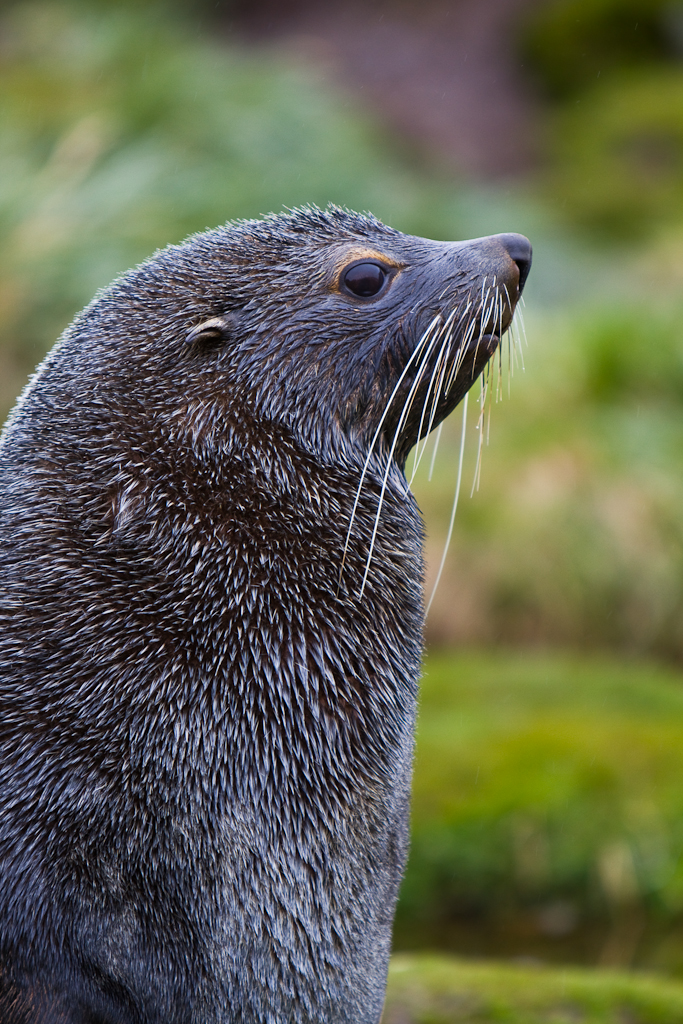
Antarctic Fur Seal Adult Male
Canon 7D, 70-200 f2.8L, 1/160th @ f2.8, ISO 200

This one is an adult male. Not one of the really big ones, but a sizable fellow nonetheless. The males, gratefully, are usually confident in their status and don't feel the need to attack every human that walks by. I'm grateful for this because the few big ones I've been charged by have been much harder to dissuade with a pointy stick.

I like the big guys though. They look so arrogant with their noses in the air, eyes half-closed in disdain at the rest of the world.

Though I do think they'd look much better with a big red circus ball balanced on their nose. Maybe I'll bring one on my next trip.

Wednesday, February 17, 2010

South Georgia Predators: Giant Petrels

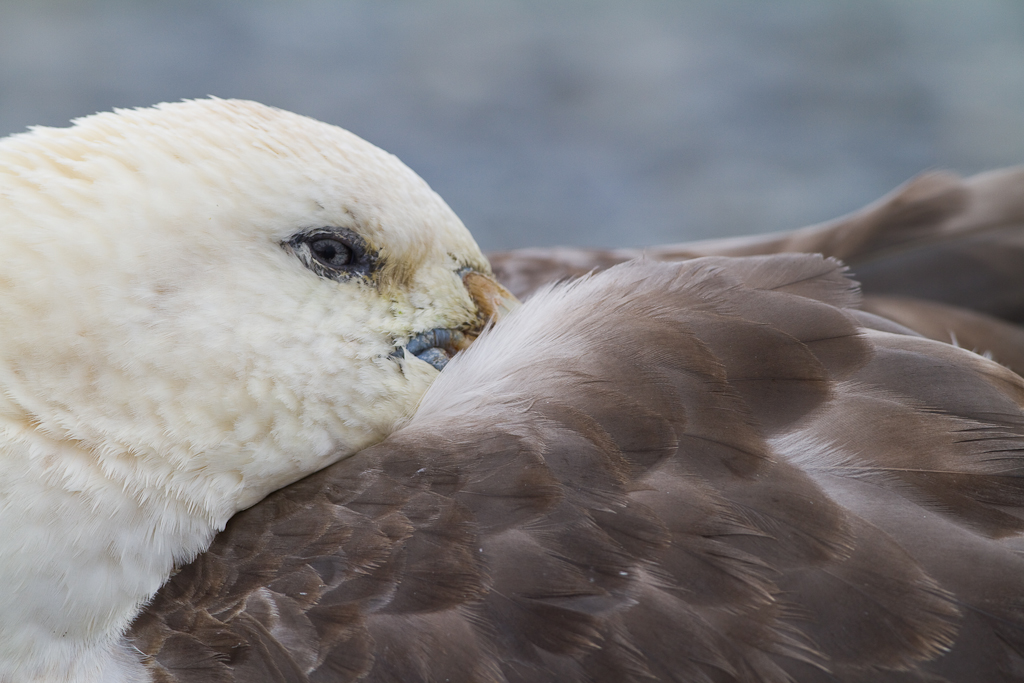
Napping Giant Petrel
Canon 7D, 500mm f4L IS, 1/250th @f5.6, ISO 100

There are two species of Giant Petrels patrolling the Southern Ocean, known simply as Northern and Southern Giant Petrels. It would be great of course if their names actually meant there was some delineating line between the two, unfortunately, there isn't. They are of the same size and general shape, and their plumages are similar and they are often found in the same places. Separating the two, particularly at sea, is not always an easy task. Northerns have an orange tip to the bill and the eye is usually pale. While the Southern has a greenish tip to the bill and a generally dark eye.

So there you go, got that?

So what's the bird in the image? The bill is out of sight, tucked into the back feathers of the bird. But the eye, conveniently is open. The color? Gray. Thus, Northern Giant Petrel.

There is your birding tip of the day. Enjoy.

Now these things are the size of albatross. 6 feet from wing tip to wing tip and can be absolutely wicked predators. Primarily the Giant Petrels are scavengers, feasting on whatever nature provides, but occasionally they will cooperatively gang up on and kill things as large as elephant seal pups. It is unpleasant at best to watch 15 of these hulking birds reaching into the guts of a dead seal, blood smattered across their pale feathers and gore dripping from their beaks. In action, it is hard to believe that these birds are the same ones that nap so contentedly on the beach. Their long sharp bills tucked daintily into the soft feathers of their back.

If however, you are an injured or dying seal, many pairs of those lovely gray eyes will be the last thing you ever see.

Monday, February 15, 2010

Predators of South Georgia

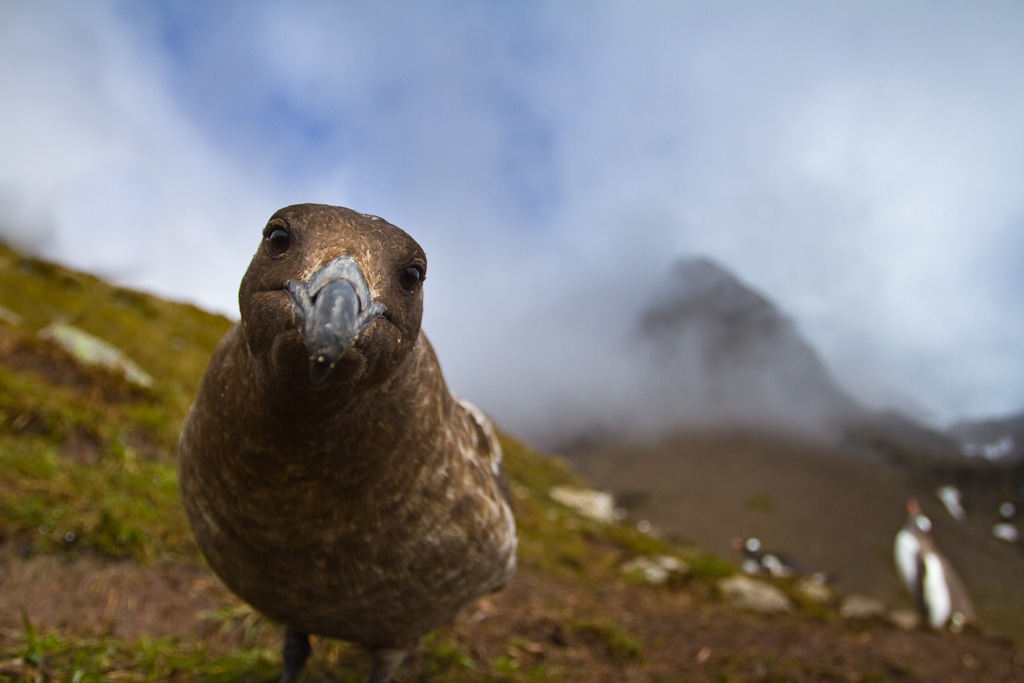
Curious Skua
Canon 7d, 17-40 f4L @17mm, f4, 1/2500th, ISO 200

It's a remote and isolated oceanic island, far, far from the mainland of South America and even farther from Africa. South Georgia Island has no native land mammals (though rats, mice, and reindeer have been introduced). No foxes, no wolves, no badgers, coyotes, squirrels, or weasels. It would seem that the local nesting birds, the penguins and petrels, would have it easy.

They don't.

While at sea, where the birds of South Georgia spend the majority of their time, they are hunted mercilessly by Leopard Seals and Orcas. On shore, they escape the threat of their aquatic predators, but not threat of the Skuas, Gulls, and Giant Petrels that are constantly looking for an opportunity to steal an unguarded egg or small chick.

The Skuas in particular are almost universally despised by visitors to the Southern Ocean. I say almost universally, because I happen to quite like them. Like any predator, they can brutal. On the South Orkneys we watched for several minutes as a pair of Skuas pulled an Adelie Penguin Chick away from its parents and off a short cliff. The downy chick tumbled down the rocks to land at the bottom where it was set upon by the Skuas. Over the course of a few minutes, as the chick tried to escape, struggle and fight back, the Skuas killed and began to eat it. It was, in no uncertain terms, brutal.

Yet the Skuas have chicks to feed as well. They are doing what is necessary to survive, however unpleasant that may be to our eyes.

It is not their brutality that I like, but their fearlessness. Skuas have no predators on land and no reason to fear people. Like the Caracaras of the Falklands they are more than willing to approach a person. Particularly if they have reason to suspect a meal might be in the making. This Skua came up to me as I lay prone on the grass shooting the wide-angle Gentoo image from the previous post. My low angle allowed me to get this rather distinctive and humorous portrait of the bird. From a standing position the shot would not have been so compelling.

Here is a photo tip for the Southern Ocean: get low, lay still, and wait for curious predators (they are sure to arrive).

Friday, February 12, 2010

Gentoos Above Fortuna Bay

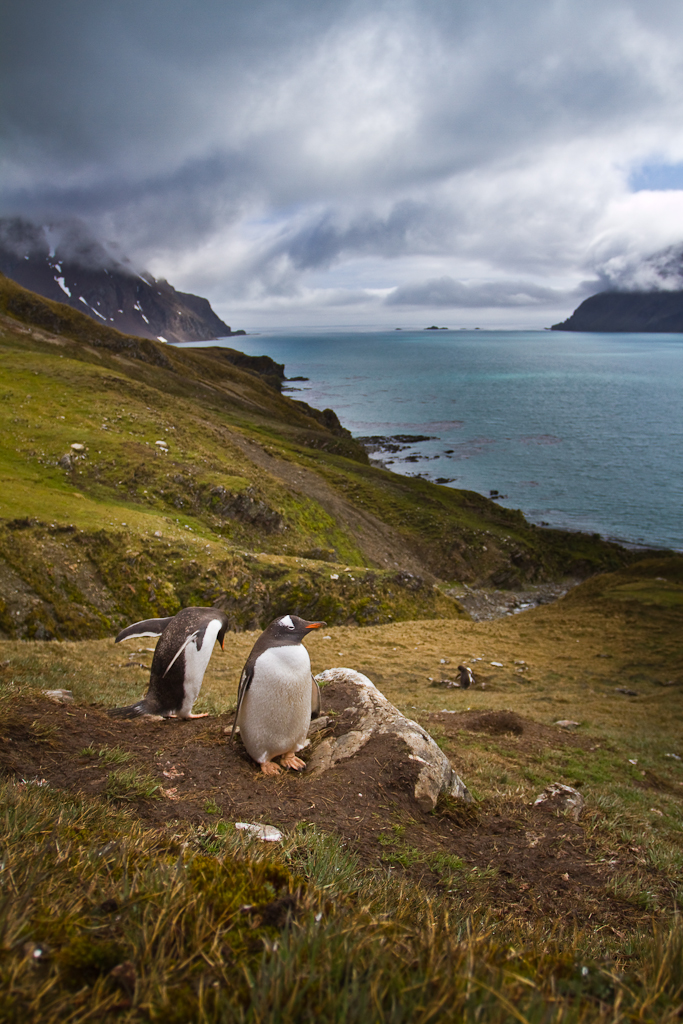
Gentoos above Fortuna Bay
Canon 7d, 17-40 f4L @17mm, 1/3200th sec, f4, ISO 200, handheld while lying down

South Georgia Island is a fjordland. All around the island are deep bays that reach into the mountainous interior of the island. Tidewater glaciers spill down to the sea from above turning the water a rich turquoise with the silt. The island is surprisingly green, particularly when compared to the shades of gray landscape of the Antarctic continent. The steep shores of the bays are covered in grass and tussocks. On a cloudy day when the glaciers and huge mountains are obscured you could almost imagine you were in Scotland or maybe the Aleutians.

Fortuna Bay lies on the north side of the island and holds the distinction of being the place where Ernest Shackleton reached the north side of South Georgia after crossing from King Haakon Bay on the south. He knew he was saved when he reached the top of the Fortuna Glacier and heard the sound of the horn from the whaling station at Stromness Bay a few miles to the east.

Fortuna carries that history, but unlike Stromness, Grytviken and other places in South Georgia, no rotting whaling station lies in Fortuna and the hand of man feels a bit more removed here than elsewhere on the island.

This was another early morning landing and I was on shore before 6am. It started off cloudy with wet snow falling intermittently. The ever-present fur seals cried from the beaches and hordes of King Penguins came and went along the shore. I climbed up the grassy slope to photograph a nesting Light-mantled Albatross. Then as tiny patches of sun came and went across the bay, I walked down to photograph a small colony of Gentoo Penguins high above the water, where I made this image.

It was quite a morning.

Thursday, February 11, 2010

The Kings of South Georgia- Part III


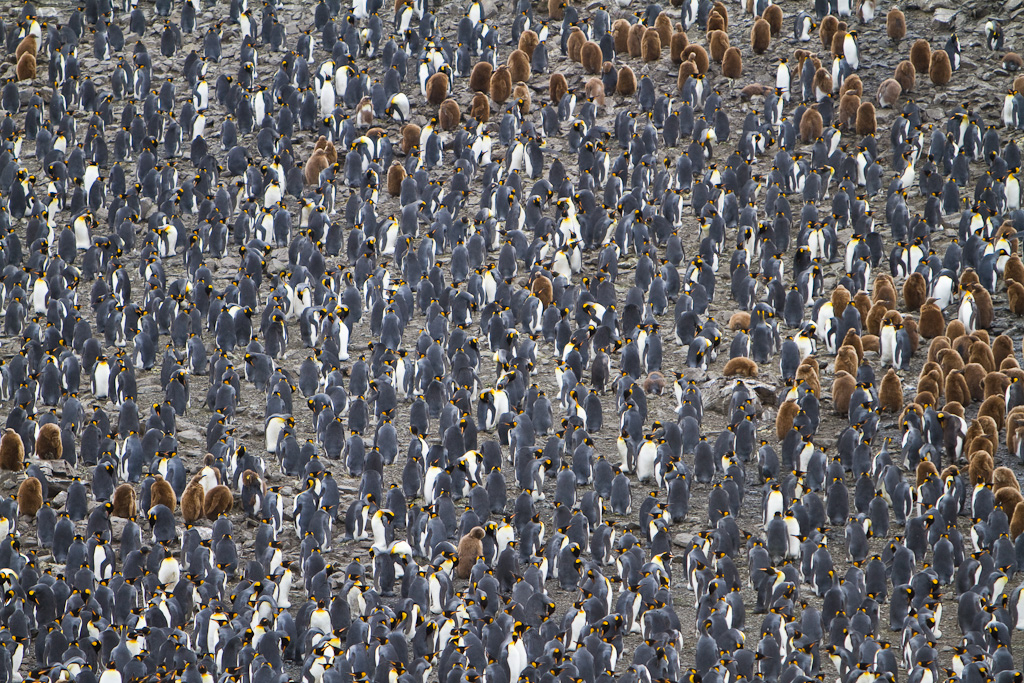
Canon 7D, 70-200f2.8 @200mm, 1/640th, f2.8, ISO 100, -1/3EV, tripod mounted

I think this will be the last of my posts featuring King Penguins. I'm ready to move on with my life.

I mentioned in yesterday's post that there was a wall of birds and seals up the beach from where I was standing. I really wasn't joking. Granted the wall was no higher than three feet, but so dense and wide it seemed insurmountable. Instead we cut inland, around the wall and walked toward the colony from that direction. From the landing site, a mile distant, the colony looks like a gray patch of ground that extends from the flats near the beach up a hill to the south. As I hiked closer, some definition arose, and the gray mass began to separate into patches of gray and brown, then, before long into the dense mass of birds themselves.

The brown birds are juveniles, called "Oaken Boys". Kings have an odd breeding schedule, that I won't take the time to describe. But what it amounts to is during the summer the colony consists of adult birds sitting on eggs and older chicks whose parents are foraging out at sea. The Oaken Boys form groups called creches that mingle about throughout the colony.

Once at the colony, there was so much noise, so many trumpets from the adults and whistles from the juveniles it was difficult to speak. There steady movement of birds coming and going, shifting, and turning made the colors feel kaleidoscopic. Photographically, I wanted to portray the density of the place and my images of the birds close to my viewing location just weren't working out. So I turned my attention to where the colony extends up the hillside. There, due to the rise of the hill, I was able to get a perspective that worked for me. I shot a few with the long lens, but I didn't feel I was telling enough of the story so I switched to the 70-200 and made the top image here.

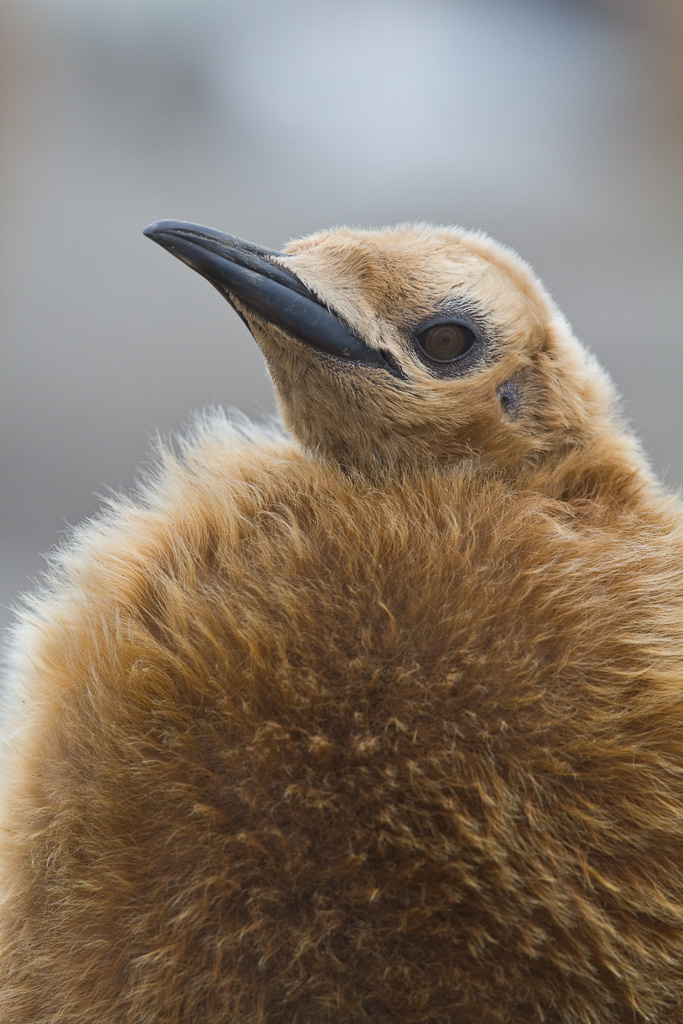
Oaken Boy
Canon 7D, 500mm f4L, 1/250th, f5.6, ISO 100, -1/3EV

This second image is a portrait of Oaken Boy. They are about the texture and shape of an over-sized Kiwi Fruit. They are also fearless and twice during that morning at Salisbury Plain I felt tugging on my backpack straps and turned to find an Oaken Boy fiddling with my gear. They are about three feet tall, and for all the world look like kids in Halloween costumes. It is nearly impossible not to be smiling when you are surrounded by all of this.

Backlit King
Canon 7D, 17-40 f4L, 1/1000th @f5.0, ISO 100, handheld

With this last image I leave the King Penguins of South Georgia Island and move on to other things. They may reappear again somewhere, but for now, I'm ready to start writing about some other aspect of the Southern Ocean.

Onward!

Wednesday, February 10, 2010

The Kings of South Georgia- continued

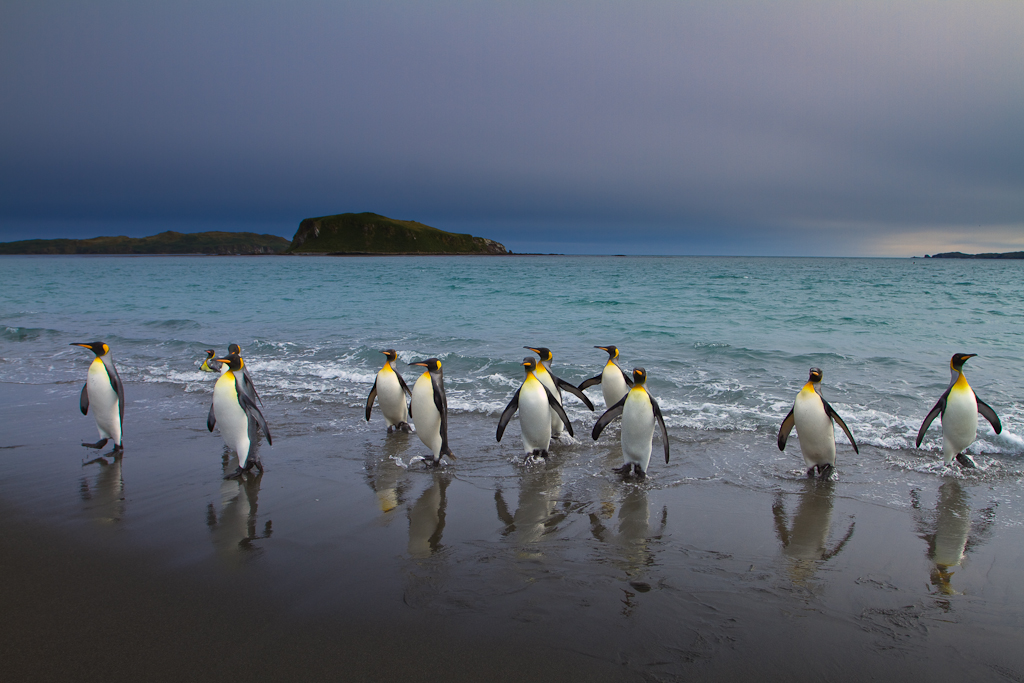
Kings fresh from the ocean
Canon 7D, 17-40f4L @17mm, 1/200th, f5.6, ISO 100, handheld

So before the rotten weather from the last post hit we had a few wonderful hours at the Salisbury Plain King Penguin colony. Honestly, I didn't spend a heck of a lot of time at the colony itself. The birds coming and going from the beach were so interesting and photogenic that I hardly got myself more than a few hundred meters from the landing location for most of the morning.

Cheesemans' Safaris works hard to get people on shore for as long as possible. And this morning, like several during the trip, there was the option for an early landing. Clients could skip breakfast in exchange for more time on shore. As staff, we weren't really given that choice, which was fine since I would have been there anyway. The early risers on this particular morning were well rewarded. Some of the best light we had on the island, we found during those early hours. After breakfast, when the lie-a-beds were making it to shore, the clouds rolled in, it started to snow, the wind picked up and within a couple of hours it looked like that video in the last post. Things change fast in the southern ocean and you can never assume you'll have a second chance.

The top image is one of several favorites from the trip. I was walking my way slowly up the beach, making photos as they presented themselves when this group of Kings erupted from the water and waddled up the beach toward me. It was almost a grab-shot, but it worked.

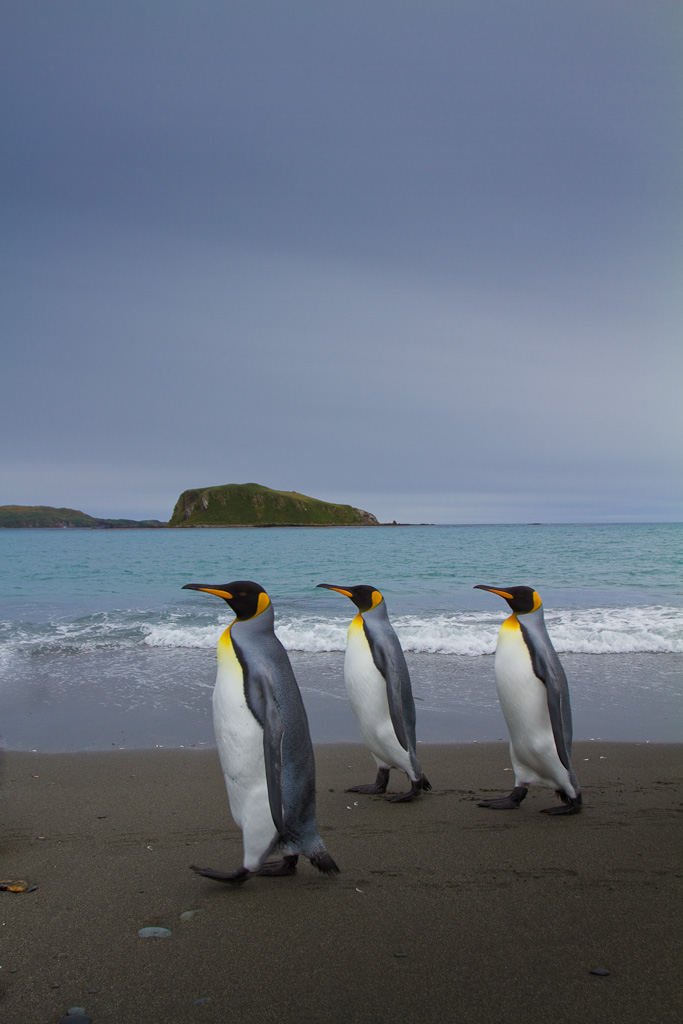
Three Kings
Canon 7d, 17-40 f4L @17mm, 1/250th, f5.6, ISO 100, handheld

This next image was made around the same time as the first. So many Kings were moving up and down the beach that I just parked myself on the sand and waited for groups to walk by. I never waited long, there was a steady stream of birds coming and going, coming and going. When I looked down the beach toward the colony it was just a wall of birds and seals.

Eventually I'll get around to posting some video clips, or if I'm really ambitious an edited compilation of the trip. Better than a photo, video shows the density and constant motion of the wildlife. But you'll just have to wait for that.

Tuesday, February 9, 2010

The Kings of South Georgia

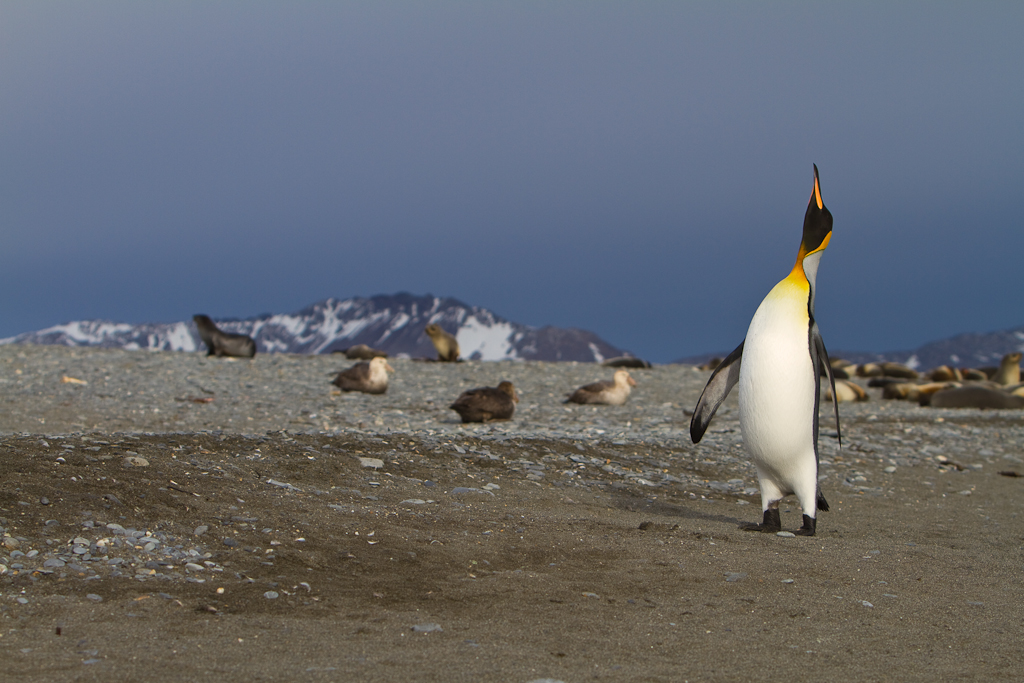
King Penguin Trumpeting
Canon 7D, 70-200f2.8L, @70mm, 1/800th, f5.0, ISO 100

South Georgia is just one of those places. It is special in the way the coastal plain of the Arctic National Wildlife Refuge is special. The way the Serengeti, Okavango Delta, Amazon, and Yellowstone National Park are special. It is a true wildlife spectacle, set upon a remote, mountainous, and glaciated island. To quote Shakespeare:

This royal throne of kings, this sceptred isle,
This earth of majesty, this seat of Mars,
This other Eden, demi-paradise,
This fortress built by Nature for herself
Against infection and the hand of war,
This happy breed of men, this little world,
This precious stone set in the silver sea,
Which serves it in the office of a wall
Or as a moat defensive to a house,
Against the envy of less happier lands,—
This blessed plot, this earth, this realm, this South Georgia Island.

Granted my change there at the end does mess up the iambic pentameter but the quote is, I think, more accurate for South Georgia than it is for Jolly Old England. Plus, South Georgia is home to a few million King Penguins and that makes the place just about perfect.

Except for the weather. The weather can really, really suck. Which it did for most of our time on the island.

We were graced with a few nice hours at Salisbury Plain, the only large King Penguin Colony we were able to visit due to the rotten weather. There I managed several decent images of the kings. The one above is a bit out of my usual style, but I like this environmental portrait. The fur seals, Giant Petrels and mountains in the background provide a sense of place.

King Penguin Abstract
Canon 7D, 500mm f4L, Tripod, 1/800th, f4.0, ISO 400

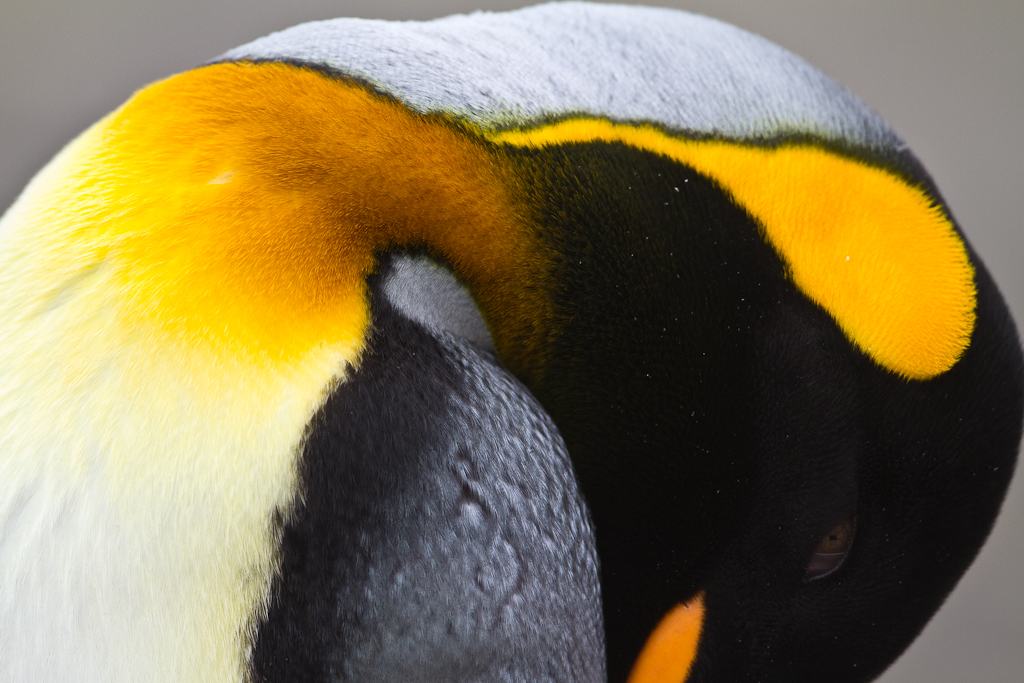
This second is not unique, but I like it. The patterns in the neck of a napping King are exquisite, and worth capturing, even if I wasn't the first to do it.

I'll be posting a few more over the next couple of days so keep your eyes open.